I recently overheard my MIL telling my husband that she has heard me say that I have ADHD, but she just doesn’t see it in me. My ex-husband has apparently also told our diagnosed daughter that he doesn’t see ADHD or ASD in her. This seems to be a pretty common experience for people observing people like us from the outside.
I can’t recall any previous noticeable instance of someone questioning my mental health experience. Of course, my whole childhood is littered with, “try harder”, “pay attention”, “just do the work”, and “I don’t understand. You’re so smart!” When I was diagnosed, a little over a year ago, I told all manner of people. My mom seems to think it fits with what it was like for her to raise me. My professors, some of whom share my diagnosis, “ooohhh” in that way that means, “everything makes so much more sense.”
Before I chose to share the new information with others, I read some accounts from peers who shared, or chose not to share, their news. So, I was already aware that I’d probably get mixed reactions.
If you don’t see my ADHD, you’re not alone. No one thought it was ADHD when I was a kid, not even me. I just thought I was not trying hard enough, and I was ashamed. I thought I was weird, broken, and destined for failure because I couldn’t figure out how to just try harder, and I wanted to hide it. In fact, long before I graduated high school, I had firmly decided I could never go to college because I was bad at school. I passed almost all of my classes and I did really well on in-class work and tests. I scored in the 97th percentile on a nationwide, standardized test once and my grandpa framed it. But if I needed to take something home or remember to bring something to school, I was practically hopeless. An incredible amount of my mental space was already occupied with simply remembering where I needed to be and when.
Of course you don’t see it in me, though. My diagnosis didn’t come until my 30’s, and I spent all the years before that figuring out how to hide my weirdness. It’s called “masking” and girls are often especially good at it. ADHD is under-diagnosed in girls for many reasons, but one reason is that we turn our forgetfulness into stress and anxiety, trying to compensate for remembering just before the deadline by doing all of the work right now.
In middle school, I had a science project that involved growing sunflowers in different conditions. I chose it in class, when sign-up sheets were passed around months before the science fair. I think I managed to remember to tell my mom maybe a week before the deadline. My flowers really didn’t stand a chance, but I got into hyper-focus panic mode and we went to the store, bought a packet of seeds, some soil, and a few pots, and started the work that night. I wish I could say this was an uncommon situation, but I would guess that I either remembered at the last minute or too late more often than not as a kid/teenager/young adult.
We ADHDers eventually realize our forgetfulness is a chronic problem, so we try to build coping mechanisms to prevent future forgetting… which can look like keeping ourselves up at night remembering all of the things we need to avoid forgetting. Prior to my diagnosis, a counselor told me I should try bullet journaling before bed, so I don’t feel like I have to hold everything in my head. That one tip has changed my life, honestly, even though I do still forget to write things down, forget to journal at all sometimes, and almost always forget to check the list during the day. I’m just more likely to remember something I wrote down, even if I don’t remember to check the list.
I spent my whole life, until the last few years, trying to be like everyone else and ending up suffering and hating myself because I couldn’t. My first marriage failed in part because of my undiagnosed ADHD. I was so willing to accept blame for just about anything, because I saw myself as broken. I always assumed that if someone forgot something or was misremembering something, it was me. I turned every mistake into a reminder to “try harder”. My ex got far too comfortable pushing that button. For example, I once forgot to bring baby food on a trip to the grocery store… where we could just buy baby food. He lost his temper, and I felt ashamed and added this to my list of motivations to try harder to seem “normal”. Eventually, the list became so long it was overwhelming and the pressure I felt to seem “normal” caused me to collapse.
Admittedly, there were many things wrong with that relationship. My undiagnosed ADHD only contributed to what I now see as the inevitable crash. The beginning of our protracted divorce was a decade ago at this point, and I’m still recovering from the somehow unexpected collapse of my precarious tower of coping mechanisms. It took many years for me to pull my self-esteem out of the resulting pit.
When I heard my MIL say she doesn’t see it in me, I guess I could (should?) have taken that as a compliment. I guess I succeeded, right? I passed for neurotypical. Instead, I cried and became physically upset because she doesn’t see a critical part of who I am, because I have worked my whole life to hide it, at the expense of my own physical and emotional well-being. I “pass” because I’d rather suffer internally than ask anyone else to “deal with” my ADHD.
I doubt she meant to suggest that she doesn’t believe I have ADHD at all. I’m not angry with her, I’m just deeply sad about how much of my life was spent feeling broken and unacceptable and trying to hide it so other people wouldn’t be inconvenienced by me. I’m frustrated by the years I spent not knowing that my “weird” has a name, and lots of other people are fighting the same battle so it’s hardly even “weird” at all. I’m disappointed that I spent so long not asking for the help I needed because I believed I shouldn’t need help. I spent over 30 years just trying to seem “normal”… and it worked.
This all sounds pretty dark; I know. Let it be known: I’m better now than ever before. I know what my brain is dealing with and I know how to ask for help. I know more about what is helpful, like breaking my thesis down into smaller, more achievable goals with shorter deadlines, bullet journaling even if I don’t look at it during the day, weight lifting and jumping rope, and tea. I used to think I couldn’t handle college, but I graduated with honors and I’m working on my master’s.
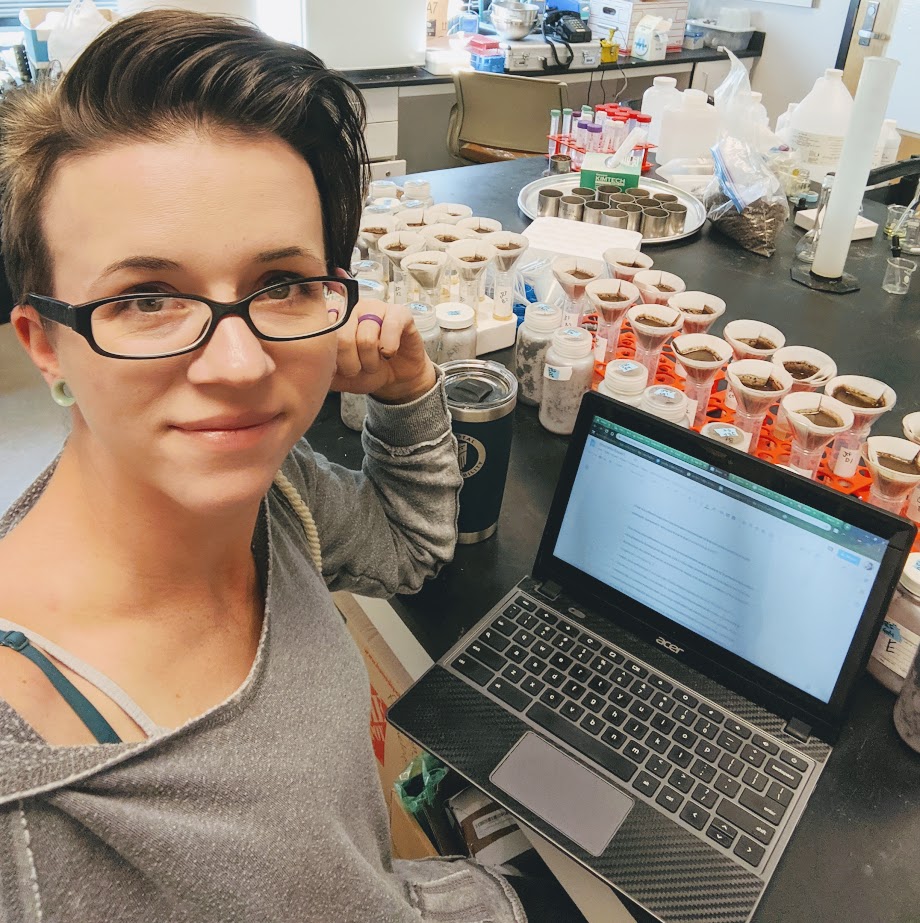
I’ve realized that I’m really quite good at scientific research because it has so many unique parts. When I get tired of reading other people’s articles for background research I just have to remember that when I’m done with this, the task will change entirely and I’ll be out collecting my own data. Then, I’ll be doing statistics and analyzing data. Then, I’ll be writing a paper. Then, presenting my findings. It never gets old because it’s always changing.
Most importantly, I’ve met people who are successful who are like me. Representation matters. I know that phrase is usually applied to groups like women, people of color, and people with disabilities. It was also true for me. To see people with PhD’s who couldn’t manage a schedule, were always in a rush or late or overcompensating for their propensity for lateness by being early, whose offices are cluttered, whose spouses bring them things they forgot on a regular basis, and who couldn’t manage to keep a conversation on track because there are far too many interesting, unrelated things to talk about… made me feel like I could be successful, too, even if it did make my undergrad research take a lot more of my time than it should have.
I learned about fountain pens, boy scouts, competitive swimming, the highest point in a bunch of states, diabetes, growing up adopted, great pyranees dogs, a heap of awesome children’s books, sustainable shoe companies, vegan cheeses, and an abundance of other extraneous topics while I was trying to work with said “people with PhD’s” on my green roof plant and soil research. It’s likely I learned less about that roof than I did about seemingly random other stuff. When it comes to my education, my cup runneth over. I learn so much more than what is in the text book or lecture because I have and enjoy these tangential conversations.
Don’t worry about me. I’m thriving, now. Or at least, I know how to thrive once this pandemic stops holding me back!
Now, if you’ll excuse me, I made myself a cup of hot tea two hours ago and just remembered it’s sitting in the kitchen.
 Master Mama Blog Home
I have felt many of these same things. I wasn’t diagnosed until I was 29 and I had to fight really hard to get help because I was actually pretty good at masking. I wasn’t able to make it through college even though I am smart enough to do really well because I just couldn’t handle the deadlines. I’d either burn myself out by hyper-focusing or forget altogether. I tried journaling to stay organized. I tried sticky notes put literally everywhere. I appreciate this article and I’m so happy that you have found help.
LikeLike
I relate to so much of what you have written here, especially around blame, shame and cold cups of tea! I’m a woman in my thirties and currently on the long waiting list for ADHD diagnosis, but I have few doubts about the outcome. It’s great to read that you are thriving through all of this. All the best to you!
LikeLike