
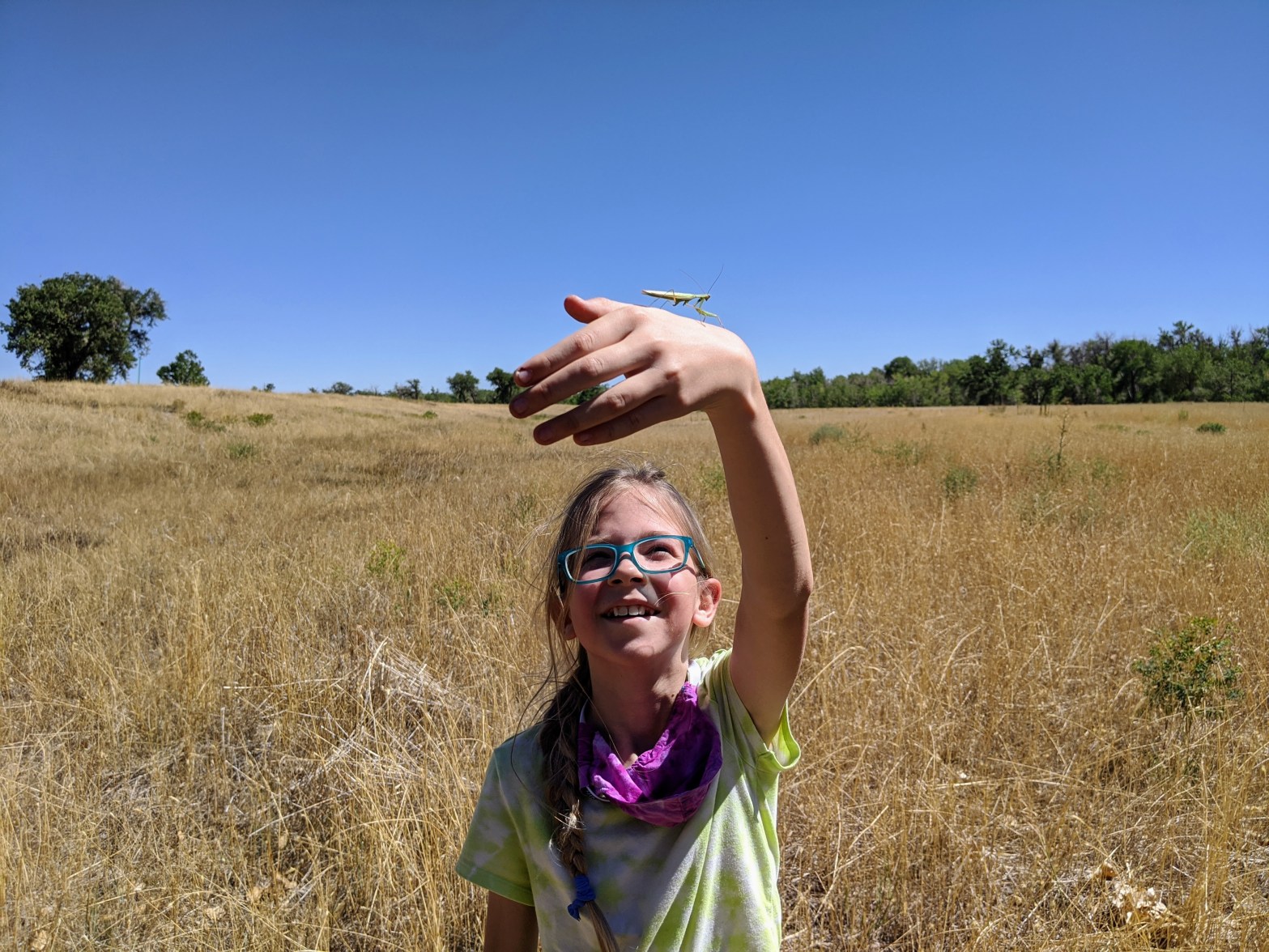
My daughter is nearly eleven years old. I often call her Miss.
Miss was diagnosed with autism a year ago, and her school just performed the battery of tests required to build her an IEP. I’m sure it is a frustrating process, even in the best of times, but the remote administration due to COVID was a special kind of miserable for Miss. Plus, Miss belongs to a bilingual Montessori charter school and several staff members are not able to come back and must be replaced because of work visa troubles caused by the pandemic. So things are a little unsettled at the school, and Miss is looking at a year that will be weird whether she is able to go back to the classroom or not.
She isn’t great with new people. The struggle is reinforced from both sides. It takes Miss a long time to even want to get to know a new person (actually, I’m not sure she ever wants to), and since she doesn’t fit with most people’s understanding of ten-year-olds, it’s hard for them to make sense of her in the classroom. A new teacher being trained in her classroom once tried to enforce the same rules for Miss as for the other kids: no leaving the classroom. Her regular teachers and the office staff were all aware that sometimes Miss needs some quiet time and had established spaces she could hide to get away from all of the noise when she was upset (In the past, she had left the school building once and, on a separate occasion, hidden inside the building without telling anyone until they called the police and me). So, being confronted with a different set of rules caused her to panic and, having nothing else around her to take it out on, she took off her plastic-framed glasses and twisted them until they broke. I’ve had to replace her glasses a couple of times due to fits of frustration.
She’s smart. She writes and reads above her grade level and, though she doesn’t believe it, she’s pretty good at math. Her processing speed is remarkably slow, and she also has ADHD, so I imagine when she does multi-step math, she gets something like a “connection timed out” error. Her school refers to her as “2e” or “twice exceptional” because she is both gifted and challenged.
What I really want to talk about here is why I chose to pursue diagnosis and an IEP. After all, Miss is passable as neurotypical to the average person. She doesn’t really struggle academically to any unusual degree. She could have potentially made it all the way through compulsory school without all of this complicated, extra work. Actually, I wasn’t even convinced that her uniqueness was something to be concerned about until shortly before her testing began.
Before I explain my reasons, I want to be very clear: This is based on my experience, my daughter’s specific behaviors and needs, and our family’s structure and values. This is not meant to persuade you to do anything differently. What works for us may not be what works for you. Also, I have made no attempt to list all of my daughters’ symptoms or struggles. That would be difficult and potentially violate her privacy.
Knowing is half the battle. I wasn’t sure Miss was autistic. I had a feeling she might be, but my idea of what autism looked like was not fully formed yet. I, like many who haven’t been exposed to the varieties of the spectrum, thought my daughter didn’t have enough of the signs to even bother with testing. I had two kids before her, and another when she was three, and they are all very different. Miss just seemed to have a more troublesome brand of differentnness.
Let me give you some examples of what I mean when I say “troublesome”. Miss could not seem to learn phonics and reading from us. I don’t think she knew any sight words until well into first grade. That’s fine, but this was when I started to really notice that Miss would smile and giggle when we were frustrated. I even wondered if Miss was pretending in order to disappoint us because she thought it was funny. This also happened when she was on timeout (often for screaming, hitting, slamming doors). We would sit with her to talk about what happened and what should have happened, and she would describe her misbehavior with grins and sometimes even struggle to complete a sentence because of her laughter. Knowing what I know now, I wish I had reacted differently at the time, but it’s upsetting to watch someone smile and laugh while you express your dissatisfaction with their actions. Now, I know that Miss often smiles when she’s upset about something. She even smiles sometimes when she’s yelling at her little brother.
I made some realizations and arrived at improved methods of handing her uniqueness on my own, before her diagnosis. Her school did the same. They listed safe spaces for her to hide when upset, as I mentioned before, but they also invited her to lunch-bunch (a social skills group) and eventually created a nature group she could lead, so she could practice being in charge and getting to know others who shared her interests. Still, it was slow and difficult and I decided we needed help. We needed a professional opinion.
Her diagnosis has empowered me to advocate for her needs at her school. Instead of simply following along with their plans and attempts to accommodate her, I’ve requested meetings with her teachers when something goes wrong so we can talk about how to avoid it in the future. I probably could have done this before. Her school is very helpful. However, I still wasn’t sure Miss really needed that kind of support, I didn’t have the words to describe the ways in which she struggles, and it always felt like the teachers knew how to handle things better than I did.
I worried that labeling her uniqueness would upset her in some way. It seemed like it might be harmful to go through life thinking of yourself as clinically different from your peers. So far, that has not been the case. Knowing that she’s different seems to have liberated Miss. Up to this point, she had gone through life believing that she was essentially no different from everyone else. So why were some things so much more difficult for her? Why did people sometimes get angry when she smiled? Smiling is supposed to make people happy. Why doesn’t anyone else get so overwhelmed by the Montessori classroom noise that they feel like they need to escape? This is what I imagine she must have thought, anyhow.
I grew up with undiagnosed ADHD and spent most of my memorable childhood assuming we were all the same, and wondering why I couldn’t get the homework done (or even get it home), why I couldn’t remember to bring paper to class, and why the only way I could manage to be on time was to be early… when everyone else seemed to be dealing with things just fine. I figured I just needed to learn whatever coping mechanisms everyone else used.
Over the years, I did figure out a bunch of coping mechanisms, often involving externalizing obligations. Alarms, lists, a designated place to put my shoes, coat, clothes, backpack, and a set time specifically for checking my backpack contents before going to bed, and asking for help all became important contents of my tool box. Having built a robust system, I finally went back to school in my late 20’s and I had almost finished my bachelors degree when I found out that my versions of those coping mechanisms weren’t just normal things that everyone did in order to successfully navigate the world… that we weren’t all the same. I struggle with time management, organization, and memory tasks more than most.
Knowing that has opened the door to a community of ADHDers who understand. It has freed my mind. I worry less about why everything seems so difficult. Instead, I know that my brain just needs some help keeping on task. Caffeine, exercise, and taking breaks all help, but I can also try prescription medication and occupational therapy if I want. Knowing what class of brain I belong to also means I know what to type into a search engine when I’m looking for solutions to something I’m struggling with. How to take notes with ADHD. How to study with ADHD. How to be a better conversationalist… with ADHD.
So, this is what I’m hoping to offer Miss. Right now, I know that knowing what class of brain she belongs to helps me parent her more effectively (trying to improve all the time), but I think it also helps her understand that the same things that work for everyone else might not work for her, and that’s okay. She’s not alone. She has a vast, diverse, and interesting community. She can type “with autism” into the search engine and someone will have had the same question and probably found an answer she can try, because people like her are everywhere. She is a type of different that has a label. Avoiding the label doesn’t change that. It just makes it harder for her to approach her problems with the right tools and connect with other brains like hers.
For Miss, I needed a diagnosis to be sure. The diagnosis lead to conversations with her teachers, which lead to the process of creating an IEP. The diagnosis also came with a lot of parenting advice and solutions for problems I wouldn’t have found on my own. I don’t yet see how any of this could be worse than going on without knowing.
 Master Mama Blog Home